




Hamilton’s Safe Apartment Buildings By-law has changed what “good building operations” look like for apartment owners and property managers. It applies to all rental apartment buildings in Hamilton with two or more storeys and six or more units that share a common space. Condos, LTC homes, licensed retirement homes, lodging homes, and housing co-ops are excluded from the program.
Affected properties now need plans, records, and maintenance practices that will withstand evaluation, renewal, and day-to-day compliance.
The by-law pushes properties toward a preventative model that identifies issues earlier, documents action, responds quickly, and shows the City that the building’s maintenance is structured. Now, you need annual registrations, documented processes, and an electrical maintenance plan maintained by a licensed electrical contractor. Below, you’ll find more details on the by-law and how Kraun can help you.
What Hamilton’s Safe Apartment Buildings By-law requires
What must be in place to remain compliant?
You must keep your required plans in place, including an electrical maintenance plan that reflects the building’s actual maintenance practices. The City expects maintenance plans to include:
- regular inspection, testing, and maintenance schedules
- up-to-date records of inspections and repairs
- procedures for proactively identifying issues
- tenant notifications for planned electrical work or service interruptions
What is required to register each year
Each year, will need to complete your registration before your registration anniversary. Registration requires:
- owner and operator details
- building information
- proof of at least $2 million in general liability insurance
- copies of the required plans (electrical, vital services, cleaning, waste, etc.)
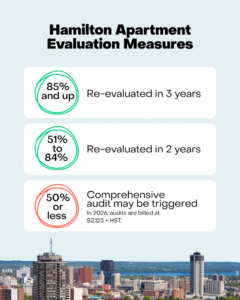
After registering, buildings are evaluated on condition and management practices. Scores are public and affect re-evaluation timelines and potential audits. See below for evaluation measures.
Why an electrical maintenance plan matters
Electrical issues are rarely isolated. In apartment buildings, they can affect corridor lighting, laundry rooms, parking garages, ventilation, pumps, communication systems, emergency power, and other services tied to safety and tenant experience. Hamilton’s evaluation criteria explicitly include lighting and electrical conditions in many of these areas.
Electricity is classified as a vital service under the by-law. If power is lost or interrupted, the issue must be responded to within 24 hours. That means a weak maintenance program can quickly turn one electrical problem into a compliance matter, an after-hours service call, and a larger operational disruption. It can also delay leasing, since vacant units should not be rented until they meet the required property standards.
Does your electrical maintenance plan hold up?
A solid electrical maintenance plan should include the following parts:
Solid recordkeeping
Documents you should have on hand:
- inspection reports
- service logs
- repair history
- known deficiencies
- outage history
- tenant complaints
- previous recommendations that were deferred.
You must prove to the City that an approved plan is being followed. Having maintenance and repair records on hand is ideal for helping an electrical contractor keep your maintenance plan on track.
Awareness of repeated electrical issues
It’s difficult to maintain your electrical system if recurring issues aren’t being tracked. You should have records of repeat breaker trips, common-area lighting failures, tenant complaints from the same stack or floor, and nuisance shutdowns.
These patterns matter more than isolated incidents because they point to underlying issues that need attention.
Pay particular attention to areas the City is likely to evaluate, including:
- lighting in common areas, exits, underground parking, and service areas
- electrical conditions in laundry rooms and shared washrooms
- tenant notification practices
Focusing only on the electrical room will leave gaps in your overall compliance picture.
Equipment tracking
A strong electrical maintenance plan also includes tracking equipment age, obsolescence, and service history. Aging equipment can become more expensive to maintain, replacement parts may be difficult to source, and recurring issues may signal the need for upgrades.
Understanding the condition of your equipment helps guide repair-versus-replace decisions and clarifies what your team can monitor internally versus what should be escalated to a licensed electrician.
That distinction matters in day-to-day operations. A strong maintenance plan is not just about documentation—it also depends on what your team is tracking internally and when a licensed electrical contractor needs to step in.
What your team should handle vs. when to call your electrician
Your on-site team should not diagnose every electrical issue. Consistently observing, documenting, and escalating electrical issues is key to the effectiveness of your plan. Here’s the division of responsibilities:
What on-site staff should observe and log
Your building team should be trained to log:
- where and when outages, trips, or intermittent issues occur
- recurring light failures in common areas
- signs of water near electrical spaces or equipment
- repeated tenant complaints about loss of power or unstable service
- emergency lighting or exit-light issues noticed during routine rounds
- whether an issue is isolated, repeated, or affecting multiple units or common areas
That kind of documentation supports the by-law’s service request process, recordkeeping requirements, and tenant communication expectations. It also gives your contractor better information to work from.
What requires a licensed electrical contractor
That electrical contractor should:
- maintain and update the electrical maintenance plan
- review service history and existing deficiencies
- assess equipment condition and maintenance frequency
- recommend appropriate testing and diagnostics, including tools such as infrared or insulation resistance testing, where appropriate
- help plan shutdowns and tenant notices for scheduled work
- provide repair-versus-replace options with budget and risk implications
- maintain documentation that you can produce if the City asks to see evidence of compliance
They will also notify the ESA of the work to be done and complete it in accordance with the Ontario Electrical Safety Code. Having the right roles and responsibilities in place is only part of the equation. The real question is whether your electrical maintenance plan would hold up under scrutiny today.
How to make sure your electrical maintenance plan holds up
Days 1–30: Validate your plan against reality
You’re registered and have your plan, but is it robust? Over the next few weeks, you need to check a few things:
- Does your plan reflect the current state of your building?
- Are you and your team following the plan?
A plan is just words on paper without proper follow-through. Compare the plan to the current service history, known issues, outages, and complaints. If there are gaps, it’s better to catch them now than just before your next evaluation when it’s too late.
Days 31–60: Identify compliance risks and pressure points
Ask yourself, if you were evaluated today, how would you score? If it’s lower than your previous score, it’s time to tighten the plan’s follow-through. The best action is to review areas that By-law officers are likely to evaluate and ask yourself:
- Have recurring electrical issues been resolved here?
- Are there deficiencies?
- Are there issues here that could impact vital services?
You want to find out if any deviation from the plan has left your building exposed to both a poor evaluation and potential electrical issues.
Days 61–90: Close the gap
Now that you’ve identified weak points in the plan, it’s time to remedy them. Focus on the big fish first: high-risk deficiencies, visible electrical issues, and repeat failure points. This is where your electrical contractor will come in handy.
From there, revisiting the maintenance plan and the actions needed to implement it is a must. Ensure you and your team have clear expectations and instructions for:
- consistent inspection routines
- basic documentation standards
- clear escalation process (team vs contractor)
With those pieces in place, your plan moves from a document to a working system that supports day-to-day operations and stands up under evaluation.
A documented electrical maintenance approach helps reduce emergency calls, protect tenant experience, improve audit readiness, support capital planning, and lower the risk of service interruptions. The real challenge under Hamilton’s by-law is not just having a plan in place, but ensuring it reflects how the building is actually maintained day to day. The buildings that do this well are easier to operate, manage, and evaluate. If you need help reviewing or strengthening your electrical maintenance plan, Kraun can assess current conditions, identify priority risks, and support a practical path to compliance. Call us at 905-684-6895 or email service@kraun.ca to connect with our commercial service department.
FAQ section
What is Hamilton’s Safe Apartment Buildings By-law?
It is Hamilton’s apartment building compliance program under By-law 24-054. It requires qualifying apartment buildings to register annually, maintain required plans, and comply with standards for maintenance, tenant communication, service requests, and documentation.
Which buildings have to register?
The by-law applies to rental apartment buildings in Hamilton with two or more storeys and six or more rental units that share a common area. Condos, housing co-ops, long-term care homes, and several other housing types are excluded.
Does the by-law require an electrical maintenance plan?
Yes. The City requires an electrical maintenance plan as one of the mandatory plans tied to registration and ongoing compliance.
Does the electrical maintenance plan have to be created with a licensed contractor?
Yes. The by-law requires the electrical maintenance plan to be prepared in collaboration with an electrical contractor holding a valid ECRA/ESA Electrical Contractor licence.
What happens if a building scores poorly?
85%+ compliant buildings are re-evaluated every three years.
51% to 84% is re-evaluated in two years.
50% or lower can trigger a comprehensive audit. The City says audit results can lead to progressive enforcement, including Orders to Comply and fines. In 2026, audit administration costs $2,123 + HST.
Are building scores public?
Yes. Evaluation scores are posted on the tenant notification board and made available online. The by-law also requires owners/operators to inform tenants and prospective tenants of the rating and its basis before lease signing and annually thereafter.
How quickly must owners respond to urgent electrical complaints?
If the issue involves a loss or interruption of vital services, including electricity, the by-law treats it as urgent and requires a response within 24 hours. Non-urgent tenant service requests require a response within five days.
Can a vacant unit be re-rented if it has electrical or vital service issues?
No, a vacant unit should not be advertised or rented unless it meets property standards, has an adequate and suitable supply of vital services, and is free of pests or suspected infestations.