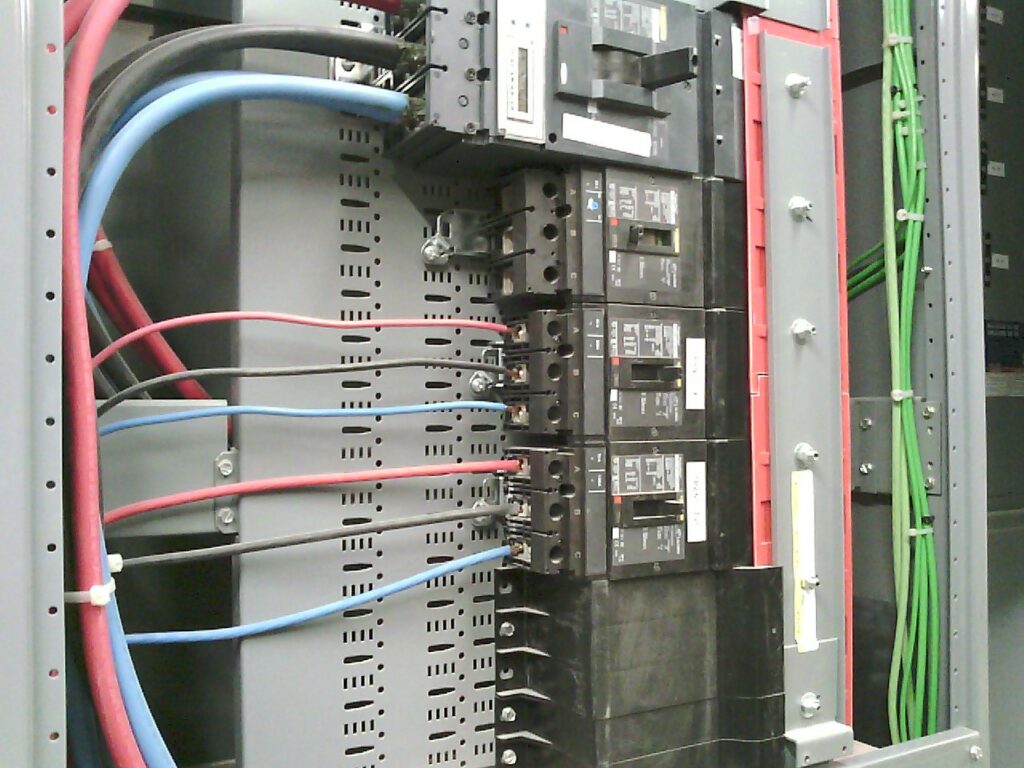




When a breaker trips in a commercial building, the immediate issue is a power outage. The bigger problem is usually what caused it: overloaded circuits, electrical faults, startup-heavy equipment, power quality issues, or deteriorating electrical components. For facility and property teams, repeated trips are rarely isolated annoyances. They are often early signs of a larger reliability issue that can lead to wider outages, production loss, tenant disruption, and expensive after-hours response.
That is why repeat trips should be treated as a maintenance and risk signal, not just an electrical inconvenience. It’s not only about getting the power back on, but also about identifying the cause, assessing the urgency, and preventing the same issue from causing further downtime. This blog will discuss common causes of commercial breaker trips and how to document and prevent recurring breaker trips.
The most common causes of breaker trips in commercial buildings
Overloaded circuits from load growth and circuit creep
One of the most common causes is simple overload. Over time, buildings change, equipment is added, HVAC and plug needs increase, etc. Sometimes, your old panel schedule is no longer sufficient.
Breakers trip when they detect overcurrent. If a circuit’s power demand has increased, the breaker may not be sufficient anymore. This is especially common in multi-tenant properties, production areas, offices with abundant IT (and space heaters!), and buildings where equipment was added without a proper load review.
What to check:
Review recent changes. Space heaters, kitchen equipment, compressors, server racks, process equipment, or tenant improvements are common culprits.
When this becomes urgent:
If the breaker trips during normal operations, or if the circuit is critical to HVAC, production, or revenue-generating spaces, the issue should move quickly from observation to diagnosis.
How to prevent it:
Review actual loading after equipment changes, update panel schedules, rebalance circuits where possible, and plan circuit additions or feeder upgrades before summer peak load, winter heating demand, or major occupancy changes.
Short circuits and ground faults
Short circuits and ground faults differ from overloads because they indicate an actual electrical fault. There are many common culprits, including damaged conductors, failing components, moisture, deterioration, and equipment defects.
In buildings, ground fault trips may occur after rain, washdowns, equipment gets wet, or equipment start ups. The biggest issue with these trips is complacency. Not because people don’t care, but rather because these faults may be intermittent and easy to overlook.
What to check:
Note whether the breaker trips instantly when reset, whether the event follows weather or moisture, or whether it is tied to a single piece of equipment or operating sequence.
When this becomes urgent:
Treat it as urgent if a breaker trips immediately after reset, if there is visible damage, burning smell, moisture inside or around equipment, or if the circuit serves a critical process.
How to prevent it:
Inspect equipment and seal enclosures prone to water exposure, replace damaged wiring or components, and avoid relying on repeated resets as a workaround.
Motor starting current and mechanical equipment issues.
Commercial and industrial buildings often have motors that start under load, including pumps, fans, compressors, conveyors, rooftop units, make-up air units, and chilled water equipment. When an AC motor is powered, the initial current can exceed 20x the normal full-load current during the first half-cycle, and remain at 4-8x the normal current for several seconds while the motor accelerates. That’s a large inrush of power at startup.
So if trips occur after systems start up, common issues could include overworking equipment, faulty components, or incorrectly set breakers for the job.
What to check:
Did the trip happen when a pump, compressor, RTU, fan, or other large mechanical load started? Has the startup become slower or louder? Have there been any mechanical maintenance issues?
When this becomes urgent:
If a critical mechanical system trips during startup, especially during peak weather or production periods, it quickly becomes an operations issue rather than just an electrical one.
How to prevent it:
Check the startup current, breaker sizing and settings, soft-starter or VFD configuration, and the condition of the motor-driven equipment itself. A breaker trip here may be the first sign of a broader equipment problem.
Harmonics and power quality problems
Commercial and industrial buildings often use equipment like VFDs, LED lighting, UPS systems, IT equipment, and electronic power supplies. Unlike simpler loads, this kind of equipment does not always draw power smoothly, which can distort the electrical system. That distortion is often called harmonics.
So if a building seems to be carrying a normal load but still has nuisance breaker trips, overheating neutrals, hot transformers, or other unexplained electrical issues, harmonics may be part of the problem. In those cases, the issue is not always how much power the building is using, but how that power is being drawn.
What to check:
Look for a pattern of hot transformers, hot neutrals, breaker trips without obvious overload, flickering lighting, or erratic behaviour from electronic equipment.
When this becomes urgent:
If the same area experiences repeated unexplained trips and there are other power-quality symptoms nearby, it’s likely urgent.
How to prevent it:
Use power quality monitoring where needed, especially after major lighting retrofits, drive installations, new IT loads, or capacity changes. Power quality problems are often solvable, but only if they are measured instead of guessed.
Loose connections, overheating, and breaker aging
Not every breaker trip is caused solely by too much current. Loose, corroded, or deteriorated connections create resistance, which causes heat, which causes failures. Circuit breakers operating in harsh environments (hot, dusty, humid, corrosive, or high-vibration) are subject to accelerated aging, which can quickly lead to malfunctions.
This is one of the most important preventive-maintenance points in the entire discussion. A circuit may pass on paper, but with wear and tear or a poor operating environment, reliability may drop long before total failure.
What to check:
From a safe distance, note burning odours, visible discoloration, hot enclosure surfaces, recurring problems on the same panel, or circuits that seem to fail more often under warm ambient conditions.
When this becomes urgent:
Any sign of heat damage, smell, discoloration, or visible deterioration should move quickly up the priority list.
How to prevent it:
Use thermal inspections and planned shutdowns for corrective work, documented condition tracking, and replacement planning for breakers or components showing age or wear.
Poor coordination that turns a local fault into a bigger outage
Sometimes the real issue is not that a breaker tripped, but the wrong breaker tripped. In a properly set-up system, only the breaker closest to the problem should trip.
A small issue should trip a small breaker, not a whole section of a building! This matters a lot in larger commercial, institutional, and industrial buildings where the distribution is complex, and uptime is a necessity.
What to check:
Did the outage affect a much larger area than the apparent problem? Did a main or upstream breaker trip when the issue seemed limited to one branch or one piece of equipment?
How to prevent it:
Review coordination studies and trip settings on critical systems. This is particularly valuable in buildings where uptime matters, where the shutdown footprint has a high business cost, or where multiple tenants or processes depend on the same distribution path.
Why this matters operationally
Regular breaker trips are annoying and a strain on operations, but more importantly, they’re a warning sign. Operationally, it’s best to note and address trips when they occur repeatedly. Waiting until there’s an actual issue only causes more downtime and headaches for you.
This is where reactive service models start to cost more than they seem. When the only plan is “call an electrician when it fails,” diagnosis starts from zero, often under pressure, sometimes after hours, and usually when operations already need power restored immediately. A preventive approach does not eliminate every trip event, but it reduces repeat failures, shortens troubleshooting time, and makes corrective work easier to plan.
What building staff should observe vs. call for
You do not need to diagnose every breaker flip for the most effective response. What you do need is good observation and documentation.
What staff should safely observe and document:
- Which breaker or area was affected?
- What equipment was running when the trip happened?
- Whether the trip happened instantly or after a delay.
- Whether weather, cleaning, washdown, or moisture was involved.
- Whether the same circuit has tripped before.
- Any visible signs from outside the equipment, such as odour, discoloration, or a repeated pattern by time of day.
A useful facility-level framework is:
- Monitor and document when: single isolated trip with obvious temporary causes, the breaker resets normally, and the issue does not repeat.
- Schedule a diagnosis when: a breaker trips multiple times, the load has recently increased, the trip is tied to a mechanical startup, or you are seeing warning signs such as heat or nuisance trips.
- Treat as an emergency when: the breaker trips instantly on reset, there is any sign of heat or damage, a main breaker is involved, moisture is present, or the outage affects critical building or production systems.
That framework helps facilities avoid both extremes: underreacting to real risk and overreacting to every isolated event.
Emergency response will always have a place. Buildings do fail unexpectedly. But if recurring breaker trips are always treated as isolated incidents, the root cause probably won’t go away. However, a stronger service model is available. One that improves record-keeping, understands the building’s critical loads, connects symptoms to causes, and solves issues preemptively. That is where the value of a long-term electrical service partner becomes practical.
Kraun’s commercial service team is ready to help maintain your business’s power distribution and prevent future major electrical issues. You can connect with us at 905-684-6895 or at kraun@service.ca.
9. FAQ section
Q1. Is it okay to keep resetting a breaker in a commercial building?
Not as a long-term response. A breaker that keeps tripping is usually responding to a real condition, and standard breakers do not typically trip without cause.
Q2. Does a tripped breaker mean the breaker itself is bad?
Not necessarily. It could be the breaker or an event in the circuit that causes the breaker to trip.
Q3. What should facility staff document before an electrician arrives?
Document which area lost power, which breaker tripped, what equipment was operating, whether the trip was instant or delayed, if weather or moisture was involved, and if the issue has happened before.
Q4. When should breaker replacement be part of the solution?
Replacement should be considered when inspection shows heat damage, deterioration, aging or wear, unreliable operation, or failure to meet load requirements.